
This makes the water system just as important as the fan itself.
Premium Mist Cooling Solution
Water Mist Fan
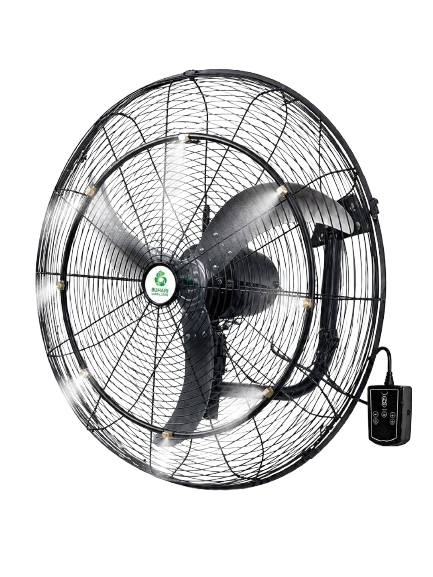
A water mist fan is designed around controlled atomization: water is delivered to nozzles or an atomizing assembly and then carried by fan airflow through an outdoor comfort zone. The result depends on filtration, pressure, nozzle condition and placement.
Solution typemist fan, water fan and evaporative mist cooling applications
Focusoutdoor cooling, air comfort and controlled misting
Usagecafes, restaurants, gardens, terraces, hotels, factories, warehouses and event areas
 REAL APPLICATION
FIELD VIDEO • MEGAMIST
See Water Mist Fan in a Real Application
Watch airflow, fine mist distribution and practical outdoor cooling performance related to Water Mist Fan. The video opens inline without leaving the product page.
Inline playbackPrivacy enhancedMobile optimized
What Is a Water Mist Fan?
A water mist fan combines a powered fan with a system that produces fine water droplets. It may be supplied from a tank or from an external pump and pipe network. Compared with a basic water-assisted fan, the project emphasis is on predictable mist quality and controlled distribution across the occupied area.
Water Mist Quality and Airflow Distribution
Fine and stable atomization requires suitable water quality, filtration and operating pressure. Blocked or worn nozzles can change droplet behavior, while unstable pressure may create uneven output between fans. These factors are checked before coverage is evaluated.
Airflow then transports the mist through the target zone. Fan angle, oscillation, nozzle position, wind and distance from people determine whether the mist evaporates effectively or reaches nearby surfaces.
Correct model selection
Tank-fed configurations suit localized mobile use where a fixed line is unavailable.
Professional positioning
Pump-fed configurations support several fans and more consistent supply across larger layouts.
How Does a Water Mist Fan Produce Cooling?
Filtered water reaches the atomizing points while the fan creates the transport airflow. Small droplets expose more surface area to the air than a coarse spray, supporting evaporation under suitable temperature and humidity conditions. The system must be adjusted so water output matches the environment rather than running at maximum output at all times.
Outdoor cooling support
Semi-open business areas
Nozzle-assisted misting
Strong air circulation
Technical Criteria for Water Mist Fans
Check nozzle material and accessibility, filtration stages, pump compatibility, line pressure, leak protection, fan airflow, oscillation and electrical protection. Water quality should be reviewed because mineral deposits can reduce nozzle performance and increase maintenance.
For multiple units, pipe routing and pressure loss are considered together with fan spacing. A visually simple layout may still perform poorly if the last units receive insufficient pressure or if wind carries mist outside the occupied zone.
Performance note: Fine mist quality depends on nozzle condition, filtration, water quality, stable pressure and fan angle. These maintenance factors are part of performance, not separate from it.
REAL APPLICATION PHOTOS
Explore Mist Cooling Systems in Real Projects
Review real application images of mist fans and cooling systems used in cafés, restaurants, industrial facilities and outdoor areas.


Application process
Water Mist Fan Engineering Steps
A successful layout aligns water preparation, pressure and airflow before the system is commissioned.
Water Quality Review
Assess filtration needs and identify conditions that may cause deposits or nozzle blockage.
Hydraulic Configuration
Define tank or pump supply, pipe route, pressure requirements and the number of active atomizing points.
Airflow Mapping
Set fan positions, heights and angles according to wind and the shape of the occupied zone.
Output Balancing
Test each fan, correct uneven misting and document filter, nozzle and leak-inspection routines.
Related services
Compare Water Mist Fan with Related Fan Solutions
Review the related pages to distinguish water mist fan from other water-assisted, misting and industrial airflow options.
Frequently asked questions
Water Mist Fan Frequently Asked Questions
These questions address mist quality, water preparation and multi-fan planning.
What is the difference between a water mist fan and a standard fan?
A standard fan only moves air. A water mist fan also introduces atomized water, so filtration, nozzle performance and environmental humidity affect the result.
Why is filtration important?
Particles and mineral deposits can restrict small nozzle openings, change the spray pattern and increase maintenance requirements.
Can several fans share one pump?
Yes, when pump capacity, line length, pressure loss and the total number of nozzles are calculated as one hydraulic system.
Will the system make nearby areas wet?
Correct atomization and placement reduce unwanted wetness, but output must still be adjusted for humidity, wind, distance and surface sensitivity.
How are nozzles maintained?
Nozzles are inspected and cleaned or replaced according to water quality and operating hours; filters and leaks are checked at the same time.
What should be included in a quotation request?
Include the number and size of target zones, water quality information if known, line distance, power availability, operating hours and photographs.
Quote and contact
Design the Water and Airflow System Together
Provide the site layout and water-supply information so pump, filtration, nozzle quantity and fan placement can be assessed as one installation.
CONTACT NUMBERS
0 (532) 282 84 860 (212) 546 55 46